Business Tips

Striping Tips and Techniques

by Exmark on October 12, 2011, under Business Tips

Everyone loves a well-striped lawn.  Whether at a Major League ballpark, or your own back yard, something about lawn striping exemplifies quality like a pinstriped business suit.  In many cases, the best lawn stripes come from a combination of cutting experience, trial and error, and good artistic sense.  At the same time, certain basic striping techniques and an understanding of what causes a good pattern can help you maximize your own craftsmanship and your lawn’s beauty.

Keep your lawn healthy

It all starts with a healthy lawn and good cut quality.  That said, striping does help unhealthy turf look a little better.  The best, most clearly defined stripes get noticed, and clear definition starts with a professional grade cutting deck.   If your lawn looks good without any striping, if you can easily achieve a “pool table” look after a fresh cut with your current mower, then you can realistically expect a quality pattern.

Make sure your equipment is properly tuned

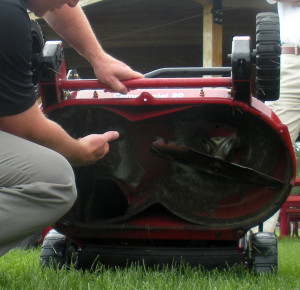
Whether you intend to stripe or not, proper deck tuning simply means that you’re maximizing the quality your deck can provide.  It should have a slightly positive rake (meaning the rear of the deck is just a little bit higher than the front), your blades should be sharp and well aligned (which can be undone after impact with any solid objects). 

With a properly tuned cutting deck, grass will stand up straight under the vacuum forces created by your deck blades in operation.  Some blades and decks have more vacuum efficiency than others, but any striping that can occur has to happen after the deck has passed.    In its essence, striping is nothing more than bending the blades of grass in one direction, uniformly across the entire width of cut, in a contrasting pattern. 

Does your deck really need a striper?

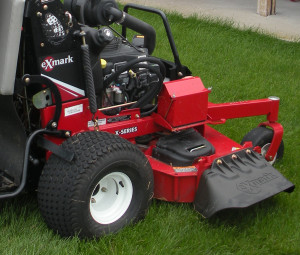
Before investing money in a professional-grade striping mechanism, you need to check a few things.  First, consider your mower.  You may already be getting a good quality of stripe from the basic design of your mower’s cutting deck.  Some decks even have a drag shield installed to protect the operator from any thrown object hazards.  While the drag shield itself has not been designed as a striper, it may do so anyway simply because it will lean grass in the direction of travel.

What type of striper works best?

Striper designs run the gamut from heavy-duty steel rollers, to flexible skirts, to brushes and chains.  Most all designs fit up to the back edge of the cutting deck, but in some cases may trail behind the mower itself.  The best choice for you may come down to personal preference based on cost, ease of installation, removal, or adjustability.  

That said, roller stripers have the lowest tendency to push, or “bull doze” material in front of the striper.  When this happens (and is most commonly seen with drag stripers), grass clippings pile up until they become heavy enough to roll under the skirt in clumps.  You may get a decent stripe, but the clumping could ruin the quality of cut.  All things considered, your dealer most often is the best source of information when it comes to matching the right striper design to your particular mower.

Can your grass hold a stripe?

Before getting started, consider the type of grass you typically mow, and the seasonal weather conditions.  Cool season grasses found in northern U.S. climates tend to stripe more effectively than in southern climates due in large part to their differences in flexibility.  The same machine and striper can, for example, achieve a crisper pattern in Wisconsin fescue than perhaps it can in Kentucky.  An example at one end of the scale can be found in Florida.  The St. Augustine grass there is so robust and rigid that it simply does not want to lean over in the direction of travel. 

How does the sun affect your stripe quality?

Regardless of how you bend a blade of grass, stripes are perceived by the light reflected from each blade of grass in contrast to the next.  The contrasting effect will vary in different ambient light conditions.  

In other words, the striping appearance will change throughout the day as the angle of the sun’s rays to the grass changes.  The most contrast is created if the directions of travel is in the same direction as the sun’s rays.  The more you lean the grass over, the more contrast you will see.

In fact, grass blades themselves tend to reflect light better on one side of the blade than the other, so this can enhance the stripe pattern in just the right lighting. 

With this in mind, you may want to experiment with the stripe direction that looks best on your lawn.  A north-south direction may reflect its pattern more consistently than an east-west direction due to the position of your lawn, and its hills and trees, in relation to the sun’s movement during the day. 

Keep your lines straight

Once you have decided on the best pattern and begun to mow, keep your lines straight by maintaining your focus far ahead.  Quite often, the closer your sight line is to your mowing deck, the more your mowing tends to wander.  This remains true whether you are striping or not.  Also, balance your speed and make sure you overlap the stripes to avoid unsightly gaps.  Going full speed may result in a lighter stripe and uneven cut, while going too slow may challenge your ability to keep a straight line.

Practice makes permanent

Remember, the best lawn stripes may come from gaining experience at what works best for your conditions.  It also comes from learning the basics.  Practicing good habits makes those habits more permanent.  If you don’t like your results, don’t lose heart.  Keep the grass healthy, review basic striping techniques, and try it again.  With each pass, you will gain experience and soon be able to transform any nice lawn into a real head-turner.

Leave a Comment :, , , more...

Who Pays?

by Exmark on June 27, 2011, under Business Tips

Of all the difficult decisions landscape professionals make every day, one of the toughest is tied to the cost of fuel. As energy prices rise, should you raise prices to compensate? Institute a surcharge? Or just absorb cost increases?
Depending on the situation, one, or a combination of options may be best action.
Some landscapers are choosing to simply raise rates to cover fuel increases. Prices of many consumer goods and services are on the rise, and customers are accepting (sometimes begrudgingly) the increases.
Others are adding a “fuel surcharge” to their fees to help customers understand why rates have gone up. Since customers are also struggling with increasing energy costs, most are empathetic with landscapers’ situations.
Still other landscapers are cutting costs where they can to maintain rates – and customers. They’re tightening their belts and finding ways to operate more efficiently and gaining customers from competitors who have raised rates.
What are you doing to balance higher energy costs? One of the above options, or something entirely different? Let us know.

1 Comment :, , , , more...

Fall Leaf Removal

by Exmark on October 01, 2010, under Business Tips

A bit of crispness in the air. The days getting shorter. Sweaters making their way out of storage. Yep, fall is heading toward us, bringing a quiet end to mowing season and a frenzied beginning to leaf removal season. Having spoken to quite a few pros in the past, we know that each one has his trick and technique to picking up leaves. And, we’d love to know what those are. Today, we’re asking you to share your personal twist on leaf removal.

We’ll start it off by sharing our “techniques,” which come in the form of attachments and a mower.

These tools quickly and efficiently get the leaves off the grass and out of sight. The attachment you choose depends on the kinds of properties you mow and your clients’ preferences. If you want finely mulched leaves spread evenly over the grass, then the Exmark mulching kit will be the tool you’re looking for. If you want finely mulched leaves collected, then check out our UltraVac® attachment and the Exmark Navigator®.

Now it’s your turn. What’s your best technique or trick for leaf removal? We’ll select one of the techniques shared and feature it and the genius landscape pro behind it in an upcoming blog post!

2 Comments :, , , , , , , , , more...

Keeping your mower safe.

by Exmark on September 14, 2010, under Business Tips, Industry News

While doing some research online, we came across a very interesting post by a part-time landscape pro, Sherri Joubert.

In her post, she talks about the fact that mower theft is on the rise. We were actually quite shocked to read what Sherri’s discovered is behind these thefts.

Sherri writes that the slumping economy and the rising unemployment rate are forcing those who are out of work to find alternative means of making money so they can provide for their families. Basically, some people are stealing mowers to start their own landscaping businesses.

Those caught in-the-act explained they were planning on returning the mowers once they’d made enough money to buy their own used equipment.

At this point we started thinking about your mower security.

To keep your mowers, well, yours, there are a few steps you can take to protect them:

  • Make sure your stored equipment is hard to get to. Reinforce your locks with heavy-duty chains.
  • Don’t leave any of your equipment unattended curb-side, even if you’re taking a quick lunch break.
  • Buy a covered trailer or a trailer with high walls.
  • Always check to make sure locks are secure.

Our final piece of advice on what you might do comes from Sherri’s own personal experience. Instead of putting her mower under lock and key, she rents her equipment for a nominal fee to a single mom in the neighborhood. The mom has access to the mowers on days Sherri is off.

Within the last couple of months, the mom saved enough money to buy her own equipment, something she couldn’t have done without Sherri’s compassion. That’s pretty powerful stuff.

What do you do to keep your mower safe? Leave your comments below.

1 Comment :, , , , , , , , more...

To Rent or to Own?

by Exmark on June 01, 2010, under Business Tips

Gas prices, economic uncertainty, unpredictable weather – there’s always something chipping away at your bottom line. You’re forced to find different ways of cutting cost and hopefully staying in the black. One thing landscape pros often think about is whether to buy or rent machines. If you’re in that camp, there are some matters to consider that may help you reach the best decision.

Start by thinking about the region you work in, the amount of time you devote to your business and the style of work you do.

If you’re just starting out, only mow part time or live in an area where lawn maintenance is a concern only a few months out of the year, then renting may be your best and most cost effective option.

Buying is a better alternative for those who’ve been in the business long enough to know exactly what they need. Also consider buying if you live in an area where lawn maintenance takes place close to year round.

You also have the option of doing both: buying core equipment, like a commercial-grade mower, and renting other tools as they become necessary.

To see even more saving solutions, check out our past posts Tax Tips and Maintenance Advice. By the way, if you haven’t read our Spring Maintenance Series, now is the time.  Proper maintenance will save you hundreds, possibly thousands of dollars later on.

Got more ideas? Share with us in the comments.

This post is by Bruce Cooper the director of sales at Exmark Manufacturing.

Leave a Comment :, more...

It’s Tax Time!

by Daryn Walters on April 08, 2010, under Business Tips

It’s April, which means you can basically count on two things: rain and taxes. Both affect your business, but one comes with some major headaches. You can probably guess which one. We’ve compiled some current tax tips that will help minimize the confusion and, hopefully, do away with the headaches.

  1. 1. There are new rules for business losses, so take advantage of them if you can. Decide whether you want to carryback or carryforward net profit losses.
  2. 2. Depreciation is not a dirty word. Section 179 allows for immediate deductions of certain fixed assets and a 50 percent bonus depreciation for new assets. A word to the wise: a current deduction is better than a deferred one.
  3. 3. Know the rules in your state. Each state has its own filing requirements and is very strict in enforcing them. Read up on your state’s rules and if you’re required to file in another state, know their policies as well.
  4. 4. Extensions happen. Since you can report taxes close to the deadline, expect extensions to happen to your business and individual returns. And don’t worry—if you file for an extension, it doesn’t mean you’ll be targeted for closer examination by the tax man.
  5. 5. Switch things around. This would be a good year to accelerate income and defer expenses. Though it’s the opposite of what you’re used to doing, it could help minimize taxes through a different account method.
  6. 6. Wishful thinking. Unfortunately for small businesses, taxes will be going up. You can take certain steps to minimize taxes now and in future years when rates go up. Of course, each state is different.
  7. 7. Don’t throw it out. Good record-keeping can save you a lot of time, money and hassle. Copies of business tax returns, licenses, incorporation papers and capital equipment expenses should be kept indefinitely. As for tax-related documents like expense receipts, client 1099 forms and vehicle mileage logs, they should be kept for a minimum of seven years.
  8. 8. When all else fails, pick up the phone. If you have any questions, you can call 800-829-4933. It’s a trouble-shooting hotline set up by the IRS specifically for small business, corporations, partnerships and trusts.
  9. 9. Tick tock. When it comes to doing your taxes, the best thing to do is not procrastinate. Getting a head start means you’ll have more time to work out any problems that may come up.

Hope this information is useful and will help to keep you on your Exmark rather than in the office doing paperwork. Now go fill out those tax forms, if you haven’t already.

Note: Exmark Manufacturing are not tax experts. For specific tax related tips, you will want to contact and leverage your tax consultant.

1 Comment :, , , , , more...